


Start with your reason for moving, not the market label. Then compare three paths: sell now, wait six months, or wait twelve. For each one, line up your likely proceeds, your next home's price and financing, and your monthly carrying costs. If selling now wins on those numbers, a slower market is not a reason to stall.
Should you sell your Tucson house in a down market?
Sell your Tucson house in a down market if you have a real reason to move and the numbers still work once you price your next home. Wait if you can carry the house comfortably and nothing is forcing your timeline. Your decision should rest on your proceeds, your replacement home, and what each month of waiting costs you, not on a guess about when prices will rebound.
Key Takeaways
- The median sale price for all home types sold in Tucson from August to October 2026 was $308,785, down 2% from $315,000 in the same window a year earlier.
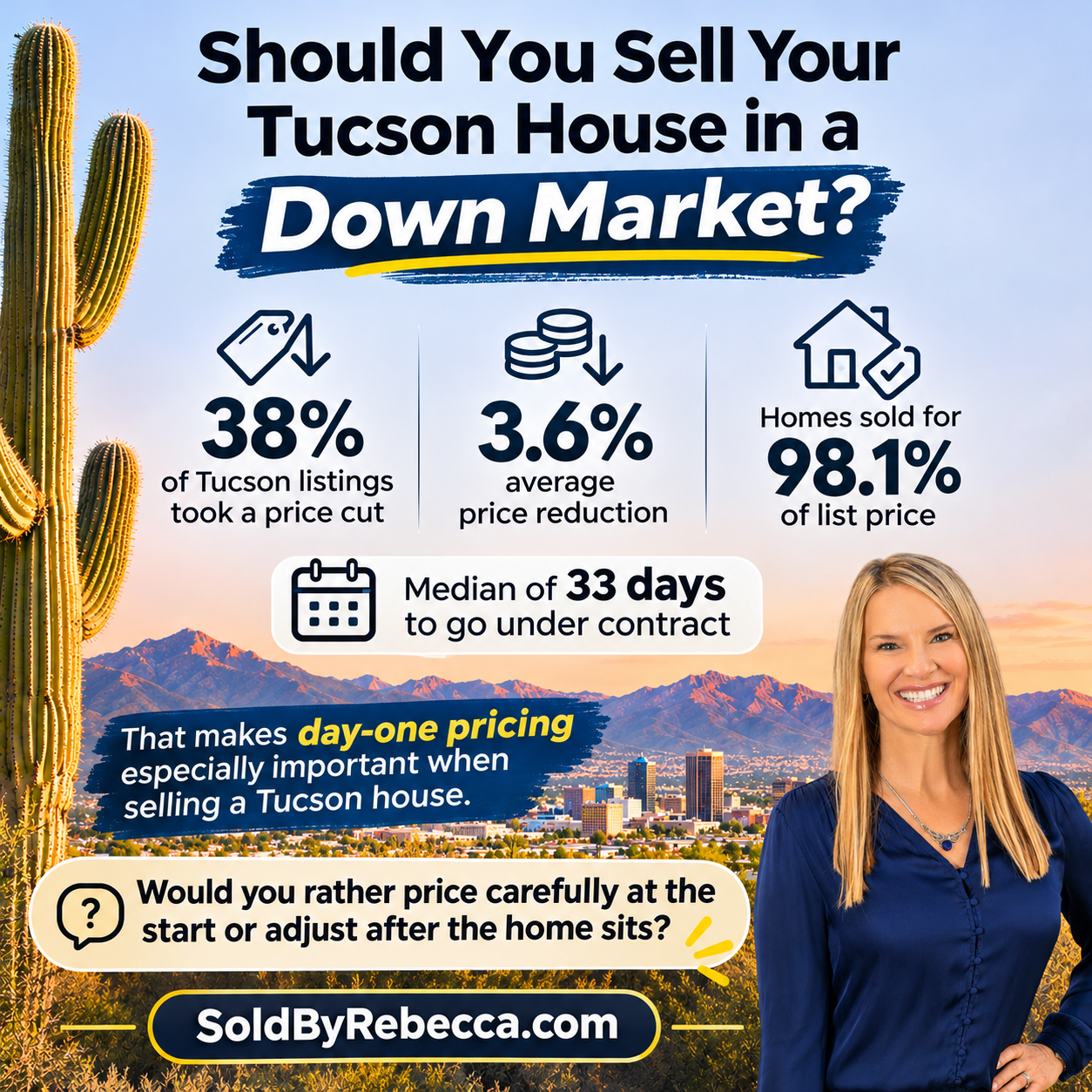
- Those homes sold for an average of 98.1% of list price, and the median time from listing to going under contract was 33 days.
- Months of supply rose to 5.6 from 4.4 a year earlier, and 38% of listings took a price cut averaging 3.6%.
- A weaker market often lowers the price of your next home too, so the real question is the gap between what you sell for and what you buy for.
- Your reason for moving and your monthly carrying costs should set your timeline, because nobody can promise when prices will improve.
Is the Tucson market really down, or just slower?
It's softer, not broken. Buyers have more choices and more leverage than they did a year ago, but homes are still selling at close to list price.
Here's what recent local market data shows for all home types sold in Tucson (within city limits) from August to October 2026:
- Median sale price: $308,785, versus $315,000 a year earlier (down 2%).
- Homes sold: 1,030, versus 1,253 a year earlier.
- Sale price as a share of list price: 98.1% on average. 20% of homes sold above list and 52% sold below.
- Months of supply: 5.6, versus 4.4 a year earlier.
- Price cuts: 38% of listings had one, averaging 3.6%.
- Median days on market (listing to going under contract): 33 days. About 27% of homes went under contract within two weeks.
Among homes for sale now, Tucson has 3,315 active listings, and 913 of them were new in the last 30 days. That's a lot of competition for your Tucson house, and buyers know it.
The Tucson Association of REALTORS® October 2026 market report points the same direction: pending listings were down 17.6% from October 2025. Fewer buyers are signing contracts. That tells you the market is slower. It does not tell you prices will fall further, and I'd be wary of anyone who says it does.
Why the citywide number is only a starting point
One median can't value your home. Condition, street, size, and price tier move the result a lot. These area medians for the same sales window show how far apart Tucson-area markets can sit:
| Area | Median Sale Price | Homes Sold |
|---|---|---|
| Oro Valley | $527,133 | 229 |
| Casas Adobes | $354,753 | 184 |
| Catalina Foothills | $684,524 | 195 |
These are area-level medians, not valuations. The comparable sales for your own street and your own price tier are what matter, and that's the first thing I pull when a seller asks me this question. For more local context, the Tucson Association of REALTORS® Q3 Southern Arizona housing brief covers sales, pricing, inventory, and affordability.
How do you decide whether to sell your Tucson house now or wait?
Separate two questions: your personal timing and the market's timing. You control the first. Nobody controls the second.
Start with why you're moving
A job relocation, a divorce, an inheritance, health or accessibility needs, or a replacement home you've already secured can make selling now the right call, even if you'd love a stronger market. If you have no deadline and no pressure, waiting is a fair choice too. Be honest about which one you are.
Add up what waiting costs you
Delay isn't free. Before you decide to hold, compare these monthly costs:
- Mortgage interest
- Property taxes and homeowner's insurance
- Utilities and routine maintenance
- Repairs you'd likely face or have been putting off
- Association dues, if your home has them
- Vacancy risk, if you've already moved out
- The equity sitting in the house instead of working for you
These are inputs for your own math, not a standard Tucson "cost to wait." Yours depends on your loan, your property, and your plans.
Price the home you'll buy next
This is the step sellers skip. If you're staying in the Tucson area, a softer market can lower your sale price and your next home's price at the same time. What matters is the difference between the two, plus your financing terms and available cash. Mortgage rates change what a replacement home costs you each month, so talk to your lender before you assume selling now or later is the better deal.
Run three scenarios side by side
I walk my clients through a simple comparison before we talk about listing. Fill it in for each path:
| Scenario | What to compare | Question to answer |
|---|---|---|
| Sell now | Expected proceeds, replacement-home price and financing, repairs needed | Does this plan work on today's numbers? |
| Wait six months | Six months of carrying costs, any repairs that grow, possible change in price | What do I gain if the market improves, and what do I lose if it doesn't? |
| Wait twelve months | A full year of carrying costs, the personal cost of postponing the move | Can I afford to be wrong about the timing? |
If waiting only wins when prices rise, that's a bet, not a plan. Your specific numbers depend on your home's condition, location, and your next purchase. That's where a local market analysis comes in.
How do you sell a Tucson house well in a slower market?
Price it to the buyers who are actually out there on day one. With 38% of Tucson listings taking a price cut, I'd rather see you set the right number at the start than watch the home sit and chase the market down.
Sell first or buy first?
Neither is always better. Selling first gives you a clear budget and a firm closing date, but you may need temporary housing. Buying first gives you more control over your next home, but you carry two properties until the sale closes. If you're considering an offer that depends on the buyer selling their own home, read my take on whether Tucson sellers should accept a contingent offer. And if a buyer's appraisal comes in under your price, it helps to know how a low appraisal plays out before it happens to you.
Know your costs, without guessing at numbers
Selling a Tucson house comes with several cost categories: the escrow officer's fees, title insurance, prorated property taxes, any HOA transfer fees, and agent compensation. Broker fees are fully negotiable and not set by law, and any compensation a seller offers a buyer's agent is optional and separately negotiable. Your net depends on your contract and your closing date, so I'd rather build you a personalized net sheet than hand you a generic number that won't match your sale.
Make the house easy to say yes to
When buyers have 3,315 homes to compare, condition and presentation carry more weight. Fix what an inspection will flag, keep the home clean and well lit, and market it widely so it reaches buyers beyond your street. A slower market rewards sellers who are prepared.
Curious how past clients felt about the process? You can read my reviews on Zillow and Realtor.com.
FAQ
Should I sell my Tucson house now or wait for prices to improve?
Sell now if you have a firm reason to move and the numbers work today. Wait only if you can carry the house comfortably and accept that prices may not rise. The median sale price for all home types sold from August to October 2026 was down 2% from a year earlier, which is a modest dip, but nobody can promise what comes next.
Is Tucson still a buyer's market?
It leans that way compared with last year. Months of supply for homes sold from August to October 2026 was 5.6, versus 4.4 a year earlier, and 52% of those homes sold below list price. Still, the average home sold at 98.1% of list, so well-priced homes are moving.
How long does it take to sell a house in Tucson?
The median home sold from August to October 2026 went under contract 33 days after listing, and about 27% did so within two weeks. That's the time to an accepted offer. Closing takes additional time, which your escrow officer will outline once you're under contract.
Is it better to sell first or buy first in Tucson?
It depends on your cash, your financing, and your tolerance for risk. Selling first gives you a firm budget but may mean temporary housing. Buying first gives you more choice but means carrying two homes for a while. Talk with your lender before you commit to either order.
What carrying costs should I compare before delaying a sale?
List your mortgage interest, property taxes, insurance, utilities, maintenance, repairs, association dues, and any vacancy risk. Then add the opportunity cost of the equity tied up in the home. Multiply the monthly total by six and twelve months to see what waiting really costs you.
A down market doesn't make the decision for you. Your reason for moving, your next home, and your monthly costs do. If you want to see what your Tucson house could net under each timeline, I'll build the comparison with you. Get a free home valuation, or start your home search if you're ready to look at what's next.
Equal Housing Opportunity. Rebecca Maher, Associate Broker; Accredited Buyer's Representative (ABR), Seller Real Estate Specialist (SRS), Graduate Realtor Institute (GRI). Regulated by the Arizona Department of Real Estate. This article is general information, not legal, tax, or financial advice. Confirm your own numbers with your escrow officer, tax advisor, or lender.