


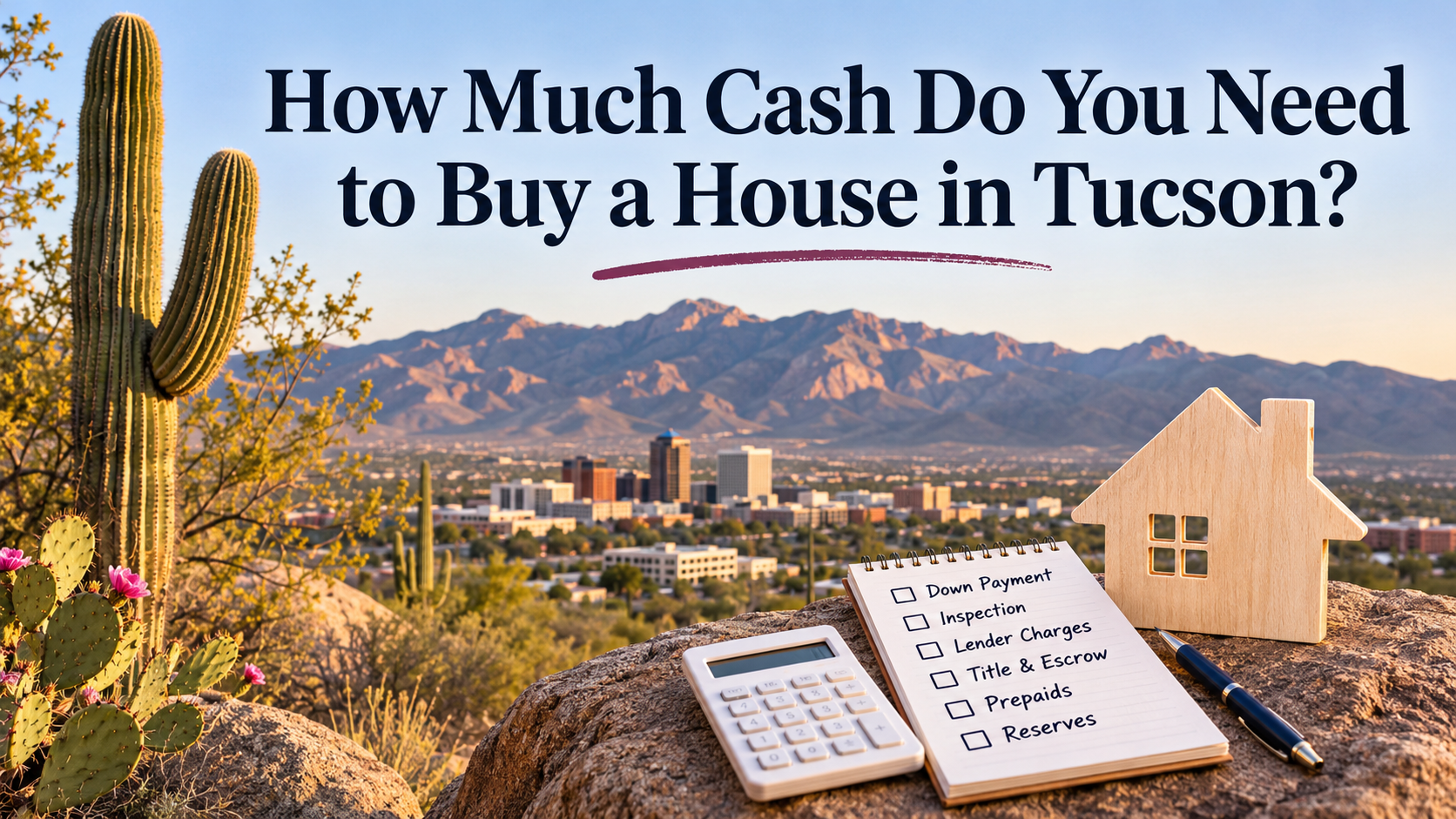
Your cash number is more than the down payment. Add inspection money you spend before closing, lender and escrow charges, prepaid items, and savings left in the bank afterward. Local assistance can shrink the check you write, but it comes with repayment rules, so get your numbers from a lender before you shop.
How much cash do you need to buy a house in Tucson?
To buy a house in Tucson, you need cash for the down payment, the inspection, lender charges, title and escrow charges, prepaid items, and reserves left over after closing. No single Tucson-wide total applies to everyone. Your number depends on your loan, the price, the closing date, the insurance and tax cycle, and what you negotiate in the contract.
Key Takeaways
- Tucson's median sale price was $308,785 for all home types sold August to October 2026 (within city limits), so your down payment scales with the price you actually pay, not with a citywide average.
- Your cash plan has two parts: money to complete the purchase, and money that must still be in the bank after closing.
- The City of Tucson and Pima County down-payment program requires you to contribute at least $1,000 of your own documented funds, and that amount includes your inspection.
- The same city and county program requires homebuyer counseling before you sign a purchase contract, so start the process before you make an offer.
- Assistance is not free cash: the city program is a deferred loan with principal repaid when you sell, and Arizona Is Home uses a second-mortgage structure.
I get this question from nearly every buyer I meet. The honest answer starts with a list, not a number. Once we know which items apply to you, the number gets a lot less scary.
What goes into the cash you need to buy a house in Tucson?
Six categories make up your cash plan: down payment, inspection and due diligence, lender charges, title and escrow charges, prepaid items, and reserves. Some are paid before closing and some at the escrow table. Here's what each one means.
Down payment
This is your largest single piece, and it moves with the purchase price and your loan type. Your lender sets the minimum for your loan. I won't guess at it here, because the right figure depends on your credit, income, and the program you qualify for.
Inspection and other due diligence
You pay for the inspection before closing, not at the escrow table. That surprises a lot of buyers. The City of Tucson and Pima County program even counts the inspection cost toward your required minimum contribution. If a repair issue comes up, you may want additional inspections. If you're eyeing an older home, my post on whether a fixer-upper is worth it in Tucson shows how I think about pricing repairs before you commit.
Lender charges
Lenders charge fees to originate and process your loan. These vary by lender and loan type. Ask for the estimate in writing and compare it between lenders.
Title and escrow charges
Your escrow officer handles the closing and the handling of funds, and title work protects your ownership. Those charges show up in your final settlement figures.
Prepaid items and initial escrow deposits
Prepaids include interest, property taxes, and homeowner's insurance that you pay up front. Some lenders also collect an initial deposit into an impound account. The amount depends on your closing date, the tax cycle, and your insurance premium. Two buyers closing on identical homes can owe different prepaids because their closing dates differ.
Reserves
Reserves are the money that stays in your account after closing. The City of Tucson and Pima County program requires the equivalent of two months of mortgage payments in the bank after closing. Even if you aren't using assistance, I want you to keep a cushion. A new home brings surprises, and you don't want to be at zero on move-in day.
Your final figure comes from your lender's closing disclosure and the escrow company's settlement figures. We compare them against your contract, any credits, deposits you already paid, and prorations. That's where I earn my keep: I read those numbers line by line with you.
Can down-payment assistance lower the cash you bring to buy a house in Tucson?
Yes, assistance can reduce the cash you bring, but you still contribute your own money, and the help usually has strings attached. Treat it as a loan with rules, not a gift.
City of Tucson and Pima County program
The City of Tucson's Down Payment Assistance Program serves eligible buyers purchasing throughout the City of Tucson and Pima County, excluding Tribal lands. Here's what the city publishes:
- Maximum assistance is $50,000 or 20% of the contract sales price, whichever is less.
- It's a deferred loan with no monthly payments and a 2% interest rate during the affordability period.
- You repay the principal when you sell. Accrued interest is forgiven after the affordability period if you meet program conditions.
- You must contribute at least $1,000 of your own documented funds, including the inspection cost.
- You need two months of mortgage payments in reserves after closing.
- You must complete HUD-certified homebuyer counseling before you enter the purchase contract, according to the program fact sheet.
That last point trips people up. If you find a house, go under contract, and then look into assistance, you may be too late. Start screening and counseling first.
Arizona Is Home
The Arizona Department of Housing describes Arizona Is Home as a down-payment-assistance program for first-time buyers in Maricopa and Pima counties. The program defines a first-time buyer as someone who has not owned real estate in the preceding three years. It limits eligibility to households at or below 120% of area median income. It works through a second mortgage, so you'll want to understand how that sits alongside your first loan.
What assistance does not do
Assistance doesn't erase the other requirements. You still deal with occupancy rules, income limits, property location, lender approval, and reserves. Whether assistance can cover your closing costs and prepaid items depends on the specific program and your lender's rules. Confirm that in writing before you count on it. I'm not a program administrator, so I send my clients to the program pages and a lender to confirm current terms. Then I help them fit those answers into an offer strategy.
How do you build your cash number before you make an offer?
Work backward from your target price. Get pre-approved, ask your lender for a cash-to-close estimate at that price, and add your reserves and inspection money on top. I put pre-approval first because a lender's real numbers beat any online calculator. My post on the Tucson home buying journey and pre-approval covers that first step.
Step by step
- Pick a realistic price range. Your down payment moves with price, so a range beats a single guess.
- Talk to a lender. Ask what your loan needs for down payment, lender charges, prepaids, and reserves.
- Screen for assistance early. If you might qualify, start HUD-certified counseling before any contract.
- Set aside inspection money. It's due before closing.
- Keep reserves separate. Don't count money you need after closing as money you can spend at closing.
- Compare the final figures. Match the lender's closing disclosure against the escrow settlement figures.
What the Tucson market means for your cash plan
Recent local market data shows a market with room to negotiate. For all home types sold August to October 2026 within Tucson city limits, the median sale price was $308,785, down 2% from $315,000 in the same window a year earlier. Homes sold for an average of 98.1% of list price, and 52% sold below list. Months of supply was 5.6, up from 4.4 a year earlier, and 38% of listings had a price cut. Recent sales that went under contract had a median of 33 days from listing to pending. There are 3,315 homes for sale now.
What does that mean for your cash? Buyers have more room to negotiate price, repairs, and sometimes seller credits toward costs. Every deal is different, and I can't promise a credit on any given home. But in a market with this much supply, it's worth asking about, and it's the kind of strategy I build into offers.
Price also varies a lot by area, which changes your down payment. Here's how three of the areas I work in compare:
| Area | Median Sale Price | Homes Sold |
|---|---|---|
| Oro Valley | $527,133 | 229 |
| Casas Adobes | $354,753 | 184 |
| Catalina Foothills | $684,524 | 195 |
These are area-level medians. An individual home's value depends on condition, street, and timing. Your cash plan depends on the home you actually write an offer on, and that's where a one-on-one conversation helps.
Ready to see your own number? I'll walk you through the full cash picture before we tour a single home, so you buy a house in Tucson knowing exactly what you need in the bank.
Want to see how my clients describe working with me? You can read my reviews on Zillow and Realtor.com.
FAQ
How much money do I need in the bank to buy a house in Tucson?
You need enough for your down payment, inspection, lender and escrow charges, and prepaids, plus reserves after closing. The total depends on your loan, price, and closing date. Your lender can give you a personalized estimate, and I'll help you test it against the homes you're considering.
What does "cash to close" include in Arizona?
Cash to close generally includes your down payment, lender charges, title and escrow charges, and prepaid items, minus credits and deposits you've already paid. Your inspection is paid before closing, so it sits outside that figure. The final number appears on your lender's closing disclosure and the escrow settlement figures.
Do I still need my own money if I qualify for Tucson down-payment assistance?
Yes. The City of Tucson and Pima County program requires at least $1,000 of your own documented funds, including the inspection cost, plus two months of mortgage payments in reserves after closing. Assistance also comes with repayment terms, so it isn't free money.
What are the income limits for Tucson and Pima County homebuyer assistance?
Arizona Is Home limits eligibility to households at or below 120% of area median income for first-time buyers in Pima County. For the City of Tucson program, check the city's program page for current eligibility details before you apply. Limits can change, so verify them with the program directly.
How much should I keep in reserves after buying a Tucson home?
If you use the City of Tucson and Pima County program, you need the equivalent of two months of mortgage payments in the bank after closing. Even without assistance, I encourage buyers to leave a cushion for move-in surprises. Your lender may also require reserves for your loan.
Your next step
The cash you need is a plan, not a guess: down payment, inspection, lender and escrow charges, prepaids, reserves, and whatever assistance you qualify for. I'll help you sort which pieces apply to you, so there are no surprises at the closing table. If you're ready, get a free home valuation if you're selling and buying, or start your home search and book a consultation with me.
Equal Housing Opportunity. Rebecca Maher, Associate Broker; Accredited Buyer's Representative (ABR), Seller Real Estate Specialist (SRS), Graduate Realtor Institute (GRI). Regulated by the Arizona Department of Real Estate. This article is general information, not legal, tax, or financial advice; confirm your own numbers with your escrow officer, tax advisor, or lender.